Direkt zum Hauptbereich

Odd Man Out (Reed, 1947) #TSPDT #469

An underground rebel is wounded during a heist and tries to evade the manhunt in Belfast.

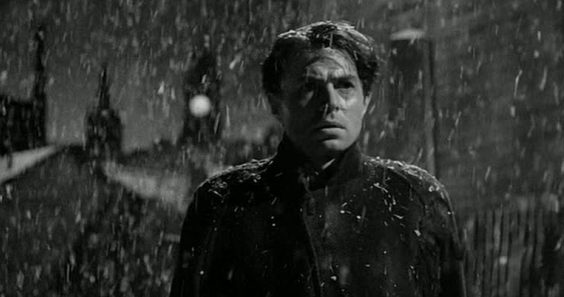
The story is of a steady decline towards the unsurprising end of terrible consequences. James Mason is quite astonishing as the soft-spoken hero, whom you just cannot imagine of doing anything as bad as scaring a child, let alone a robbery. Obviously, he does both in the film and much more. His endless odyssey which is much less about him than the various Belfastian characters towards him and - although explicitly denied by the filmmaker in a bizarre opening title card - ultimately about the struggle for independence in Northern Ireland (or any similar situation)

There were two or three moments in the film that didn't hold up for me as well as they should, but the crazy painter and his bizarre co-inhabitant made it all up - a bold selection of outright frightening men from the fringes of society. There is no need to decipher the symbolism (payoff might be even bigger) - it's simply enjoyable through and through.

As mentioned above, Mason is an extremely effective anti-hero, with his light frame, his haunting looks and there seems to be something eating away at him. Even when I watched him on a vintage TV show he radiated a kind of possession. Must be big fun to work with such an actor.

Study this for great character sketches (great film)

Kommentare

Beliebte Posts aus diesem Blog

Time of the Gypsies / Dom Za Vesanje (Emir Kusturica, 1988)

A supernaturally gifted boy from a Gypsy community is forced to survive in the world of crime. The intriguing qualities of Kusturica's films I've seen is his relentless depiction of basically crazy communities. Not just agreeably potty, they're usually outright interstellar-nuts. Here, he follows the fate of the rather harmless boy Perhan, that leaves for Italy in hope of a better future for him and his loved ones. There are some enormously interesting images in the film that kept ringing long after. The ritual in the river and the last scene in the church ruin (with a horse standing somewhere far back in the image...). After sketchily mapping out the scenes it is surprising how rigorously three-acty the screenplay is constructed. The first act seems quite long in terms of time and number of scenes, but there is also a lot of imagery spent on depicting life in this crazy universe, which makes the second part in Italy much more believable. And there is a certa...

Choked (Joong-Hyun, 2011) - #Berlinale 2012 #koreablog

A young man is confronted with his mothers worsening debts. Things spiral out of control when she suddenly disappears. Most notable about the film for me was the insight into the Korean society - the filmmakers seem to suggest that basically everyone in Korea seems to live way over their means. The pressure on the son to get a "good life" in terms of owning an apartment of good size determines the happiness of his fiancee. The characters talk plainly about the subject of money to each other with a frankness that would not be seen in other societies. I wonder if this was a fiction or conversations can be that open in Korea. Something I've noticed recently in some Asian films with a similar style is a sort of liberation of the genre, I cannot really describe it any better. At any point during this film I expected it to turn funny, bloody, dramatic or simply weird. And to a very slight degree it really turns this or that direction. Maybe it was just me, but t...

Easy Street (Chaplin, 1917) - #DTC 1819

The tramp-turned-policeman is given charge to clean up notorious Easy Street. This Chaplin was pretty coherent in story, although one can still feel his extremely strong focus on single scenes, and his longer films always lack something of an arc for me. But here the whole movie is short enough to keep me posted on the story. The centerpiece for me was the chase routine, which seemed like an enormously tuned door-in/door-out scene. But the tempo is still amazing to watch even after a hundred years. I felt a lack of this pace in Lloyd's film and in other slapstick comedies from the era and later. The general perception of comedic rhythm seems to have changed substantially over time, but Chaplin's stuff seems to work great in all eras. His arch-enemy, the fascinating Eric Campbell is a delight to watch and works as the archetypical thug.